
- LG Energy Solution, the University of Chicago, and the University of California San Diego publish joint research in Nature Communications, advancing sulfur-based all-solid-state battery (ASSB) technology.
- Through this industry-academia collaboration, the company demonstrates that all-solid-state technology provides a new platform for sulfur cathodes, improving sulfur utilization and ensuring stable cycling.
On February 27, the international journal Nature Communications published research conducted by the team of Professor Shirley Meng at the Pritzker School of Molecular Engineering (PME), University of Chicago (UChicago). The study is a key outcome of a joint battery industry-academia partnership with LG Energy Solution’s Frontier Research Laboratory (FRL) program, which is funded by the company and carried out in collaboration with the University of California San Diego (UCSD) and UChicago PME.
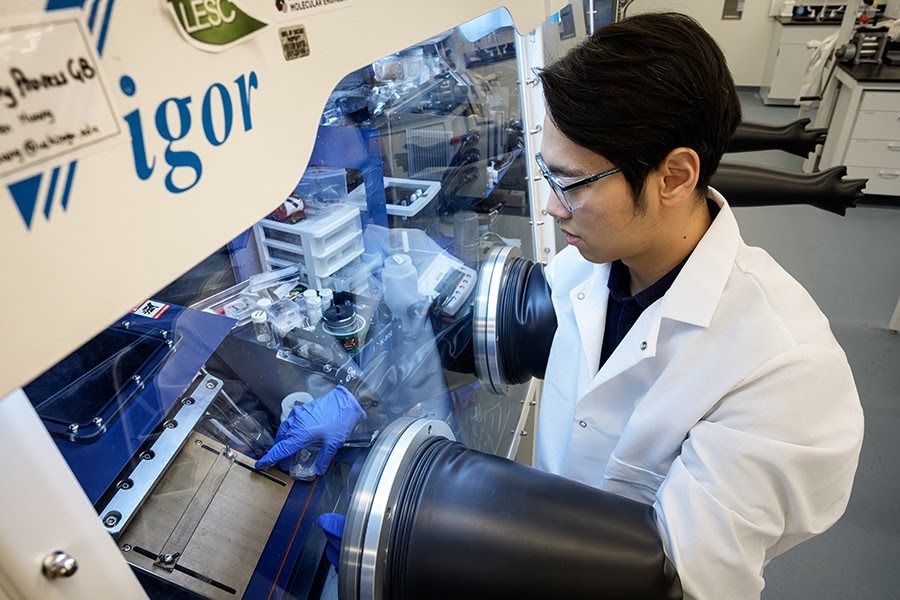
at LG Energy Solution’s Frontier Research Laboratory (FRL)
The research highlights the potential applications of using a sulfur-based cathode within all-solid-state battery (ASSB) technology. It builds on the partnership’s earlier lithium-sulfur (Li-S) work, pairing solid-state safety and stability with sulfur’s high capacity and low cost.
S&P Global Insights projects that global demand for lithium-ion batteries will more than double from 2023 levels by 2030, driven by EV growth and the rise of electrified aviation. As adoption accelerates, this research helps advance next-generation batteries with higher performance and the cost efficiency needed for large-scale industry use.
As a next-generation cathode material, sulfur has attracted interest for its low cost, wide availability, and exceptionally high capacity. However, its practical use has long been held back by a major challenge in sulfur chemistry.
In conventional batteries with liquid electrolytes, sulfur compounds formed during charging and discharging can dissolve into the electrolyte. Known as polysulfide dissolution, this causes rapid capacity loss and short cycle life, which has limited the commercial viability of sulfur-based batteries.
Improved safety is one of the main drivers behind ASSBs, especially for high-energy chemistries such as Li-S. Conventional batteries with liquid components can be prone to thermal incidents from aging or physical damage. ASSBs replaces flammable liquid electrolytes with non-flammable solid electrolytes, eliminating liquid components within the cell. To overcome polysulfide dissolution and enhance safety, the research team utilized an ASSB architecture, replacing liquid electrolytes with solid electrolytes to ensure long-term electrochemical stability and effectively stabilize the sulfur-based cathode.
To fully unlock the high specific energy of ASSBs, it is essential to establish intimate interfacial contact between solid particles. In these systems, the sulfur active material, solid electrolyte, and conductive carbon must be integrated as solid powders. However, traditional preparation methods, such as hand-mixing or multi-step milling, often fail to create a sufficiently connected network, fundamentally limiting sulfur utilization and overall electrochemical performance.
The research team addressed these challenges by developing a one-step dry-milling process that integrates all three primary components simultaneously. This approach creates a highly uniform composite architecture and induces the formation of a metastable, ionically conductive interphase. A layer is formed through a partial reaction between the sulfide electrolyte and the sulfur cathode, which facilitates lithium-ion transport and ensures that more sulfur can effectively participate in the battery reaction.
Beyond the mixing process, the size of the solid electrolyte directly affects the packing efficiency within the electrode. As battery performance depends on the effective interaction between solid particles, the research team optimized solid electrolyte particles to the micron scale to promote closer packing and superior contact, thereby significantly reducing interfacial resistance.
Building on this finding, the team optimized the particle size of the solid electrolyte powder and refined the fabrication process to develop a sulfur-based composite cathode. The result was a discharge specific capacity of around 1500 mAh per gram of sulfur, narrowing the gap with sulfur’s theoretical capacity of 1675 mAh per gram. To further validate the practical viability, the research team conducted pouch cell evaluations, which demonstrated high sulfur utilization and stable cycling. These results underscore the scalability of the process and its strong potential for next-generation EV applications.
“Instead of adding new materials or coatings, this work shows that simply arranging the existing materials more carefully allows sulfur to react much more efficiently,” said an LG Energy Solution official. “By optimizing particle size and how the materials are mixed, the battery can deliver high capacity, practical energy output in an all-solid-state design.”
Beyond energy performance, the study also examined battery “breathing,” the expansion and contraction of materials during cycling that can cause mechanical stress and degrade performance over time. This is especially important for ASSBs that use high-capacity conversion-type electrodes (e.g., Si), since these materials can expand significantly when they react with lithium.
To reduce this effect, the research team paired high-capacity silicon anodes with sulfur-based conversion chemistry. Sulfur-based electrodes exhibit volume-change behavior opposite that of conventional nickel-manganese-cobalt (NCM) cathodes. The researchers leveraged this complementary behavior by pairing a silicon (Si) negative electrode with a lithium sulfide (Li₂S) positive electrode, and, in the corresponding lithiated state, a lithiated silicon (LiₓSi) negative electrode with sulfur (S). This out-of-phase relationship allows expansion on one side of the cell to partially offset contraction on the other, helping balance internal pressure and maintain stability during cycling.
The findings emphasize the need for battery technologies that perform reliably beyond the laboratory and on an industrial scale.
“This achievement is significant in that it confirms the possibility of expanding energy capacity beyond conventional lithium-ion batteries by applying sulfur cathodes.” An LG Energy Solution official said. “Based on collaboration between industry and academia, we will continue expanding next-generation battery technologies that simultaneously secure safety, energy density, and cost competitiveness.”
+ To stay up to date with the latest news from LG Energy Solution, click “Subscribe.”