
- As physical AI and humanoid robots move closer to commercialization, the robotics battery market is projected to expand across logistics, manufacturing, healthcare, and other sectors.
- LG Energy Solution strengthens its position in the emerging robotics market with high-performance cylindrical batteries, partnerships with more than six major global robotics companies, and cutting-edge immersion cooling pack technology development.
As physical AI accelerates the transition of advanced robots from concept to commercialization, the robotics industry is entering a new phase of growth that creates innovative opportunities across the battery value chain. Reliable, high-performance batteries will be vital for this evolution, making battery technology a key area of competition as robotics applications expand across industries. LG Energy Solution is strengthening its position in this emerging market, already supplying high-nickel NCM-based 2170 cylindrical batteries to more than six major global robotics companies and building partnerships as the industry moves toward broader commercialization.
According to Research and Markets, the robot battery market centered on industrial and service robots is projected to grow at a steady compound annual growth rate (CAGR) of approximately 12 to 13 percent. This includes demand across the logistics, manufacturing, and healthcare sectors, driven by growth in the humanoid battery segment.
Industry forecasts point to significant long-term growth in the humanoid robotics market as advances in artificial intelligence, sensing, and motion control accelerate commercialization. As this emerging market moves closer to commercialization, opportunities for high-performance battery solutions are expanding rapidly, creating new avenues for value creation through technological innovation.
Different Robots Require Specialized Battery Technologies
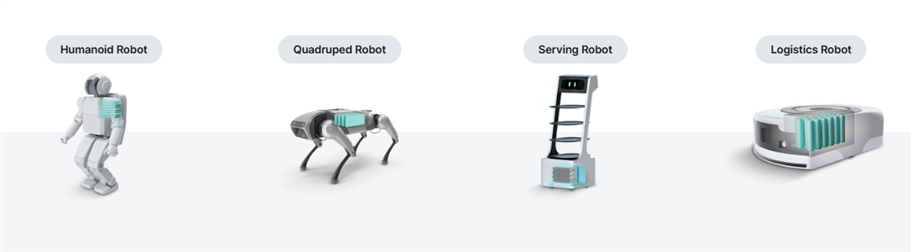
Different robotic platforms, including humanoid, quadruped, serving, and logistics robots, have distinct battery requirements shaped by their mobility, operating environments, and applications. Among them, humanoid robots resemble human form and movement, allowing them to use tools and operate within human environments. This makes them well-suited to undertake tasks in hazardous or hard-to-access settings.
Quadruped robots use four legs to offer strong terrain adaptability and stability, built for autonomous navigation and logistics transport in complex indoor and outdoor environments. These four-legged machines are being widely used in disaster response, industry facilities, and security fields, further broadening the scope of battery demand.
How LG Energy Solution’s Batteries Meet Robotics’ High Demands
Robotics batteries must deliver uncompromising levels of energy density, power output, and safety while still accommodating the space and performance constraints of different robotic platforms. Unlike EV batteries, which are installed in a lower chassis, most humanoid robot batteries are limited to a small space inside the torso. Another challenge is highly dynamic movements, such as jumping, tumbling, and running, which require high battery power output instantaneously. At the same time, maximizing operating time within limited space demands high energy density. That is why high-energy-density NCM batteries are preferred, along with cylindrical batteries that can support robust safety performance and greater pack-design flexibility, strong safety performance, and greater design flexibility.
In an evolving robotics market, LG Energy Solution meets all three critical requirements of robotics batteries: safety, high energy density, and high-power output. Backed by over 30 years of battery technology expertise in lithium-ion battery development, quality management, and global production, the company ensures stable supply. With its large-scale manufacturing experience and track record of supplying high-quality batteries, the company has built a level of customer trust hard to match.
As physical AI moves from concept to commercialization, battery systems’ performance and reliability will be decisive in determining the speed of robot deployment at scale across industrial, logistics, healthcare, and security environments. With validated high-nickel NCM-based cylindrical batteries already being supplied to world-leading robotics companies, along with ongoing next-generation collaboration and advanced safety technologies such as immersion cooling, LG Energy Solution is strategically positioned at the center of this transformation.
LG Energy Solution Expands Robotics Partnerships and Battery Innovation
LG Energy Solution is supplying its validated high-energy-density, high-power, high-nickel NCM-based 2170 cylindrical batteries for various robotic platforms, while coordinating specifications and mass production timelines with leading robotics companies. The company supplies cylindrical batteries to more than six major global robotics companies and is also providing samples for next-generation models, reinforcing its presence at this critical early stage.
At the same time, LG Energy Solution is co-developing immersion cooling pack technology to enhance safety and performance. As demand accelerates, the company is sharpening its competitive edge while expanding into diverse robotic applications.
How Battery Technology Unlocks the Full Potential of Robotics
Battery performance and reliability are important to the wider commercialization of robots across industrial, logistics, healthcare, and security environments. As robotic applications expand, batteries must meet demanding requirements for power output, operating time, and safety while accommodating the design constraints of different platforms. Continued advances in battery technology will support the broader deployment of robotics as physical AI becomes more commonplace.
FAQ
Q: Why do humanoid robots require high-performance batteries?
A: Batteries for humanoid robots must deliver high energy density and instantaneous power output within a limited installation space. Their dynamic movements, including walking, running, and other complex motions, make battery performance and reliability crucial for operating time and functionality.
Q: Why are cylindrical batteries used in robotics?
A: A cylindrical battery’s form factor supports a flexible battery pack design. Their suitability for robotics depends on the specific platform’s requirements, including available space, power demand, operating time, and safety considerations.
Q: How is LG Energy Solution advancing battery technology for robotics?
A: LG Energy Solution supplies batteries to over six major global robotics companies and provides samples for next-generation robot models. It is also coordinating specifications and mass production timelines with robotics partners while co-developing immersion cooling pack technology to enhance battery safety and performance.
Q: How will physical AI drive demand for robotics batteries?
A: Physical AI will let robots perform increasingly complex tasks in real-world environments, meaning batteries that balance energy density, power output, operating time, and safety will become more desirable. Potential applications span industrial operations, logistics, healthcare, and security, creating opportunities for further battery technology development.
Q: How do battery requirements for robots differ from those for electric vehicles (EVs)?
A: Robot batteries must deliver high energy density, high power output, and safety within a limited installation space while supporting dynamic movements. While EV batteries are installed in the lower chassis of a vehicle, humanoid robot batteries are typically housed in the torso. This creates completely different space and performance requirements.
+ To stay up to date with the latest news from LG Energy Solution, click “Subscribe.”
Last Updated: October 2026