
- LG Energy Solution is advancing LFP battery technologies for EV and ESS applications through innovations in cell manufacturing and pack integration.
- LG Energy Solution is expanding its LFP business across ESS and EV applications, supported by localized production capabilities and a diversified range of battery formats.
As electric vehicle (EV) and energy storage system (ESS) markets expand, lithium iron phosphate (LFP) batteries are gaining traction as a cost-competitive and reliable technology. Global automakers are increasingly adopting LFP batteries, particularly for more affordable EV models, while the expansion of renewable energy and rising electricity demand from AI data centers are creating new opportunities for LFP-based ESS solutions.
Recent market analyses indicate that LFP batteries accounted for more than 55 percent of global EV battery capacity installed in 2025 and approximately 90 percent of global battery storage additions. This reflects LFP’s ability to serve diverse applications with different cost, safety, and durability requirements. As demand grows, LG Energy Solution expects advances in cell and pack design will be essential to improving LFP performance and broadening its use across EV and ESS markets.
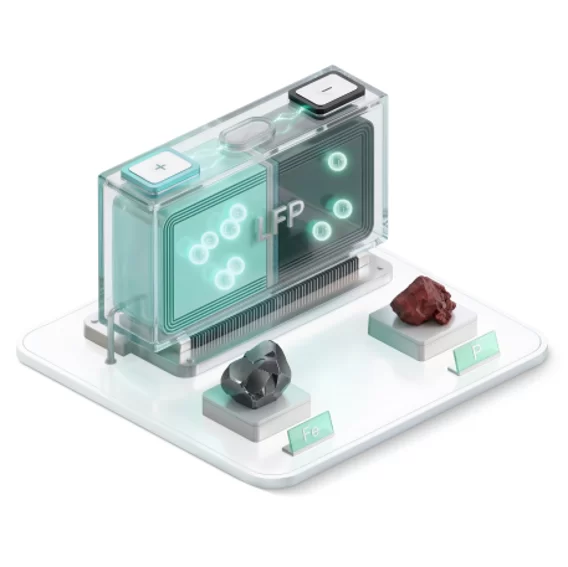
Why LFP Batteries Are Gaining Traction
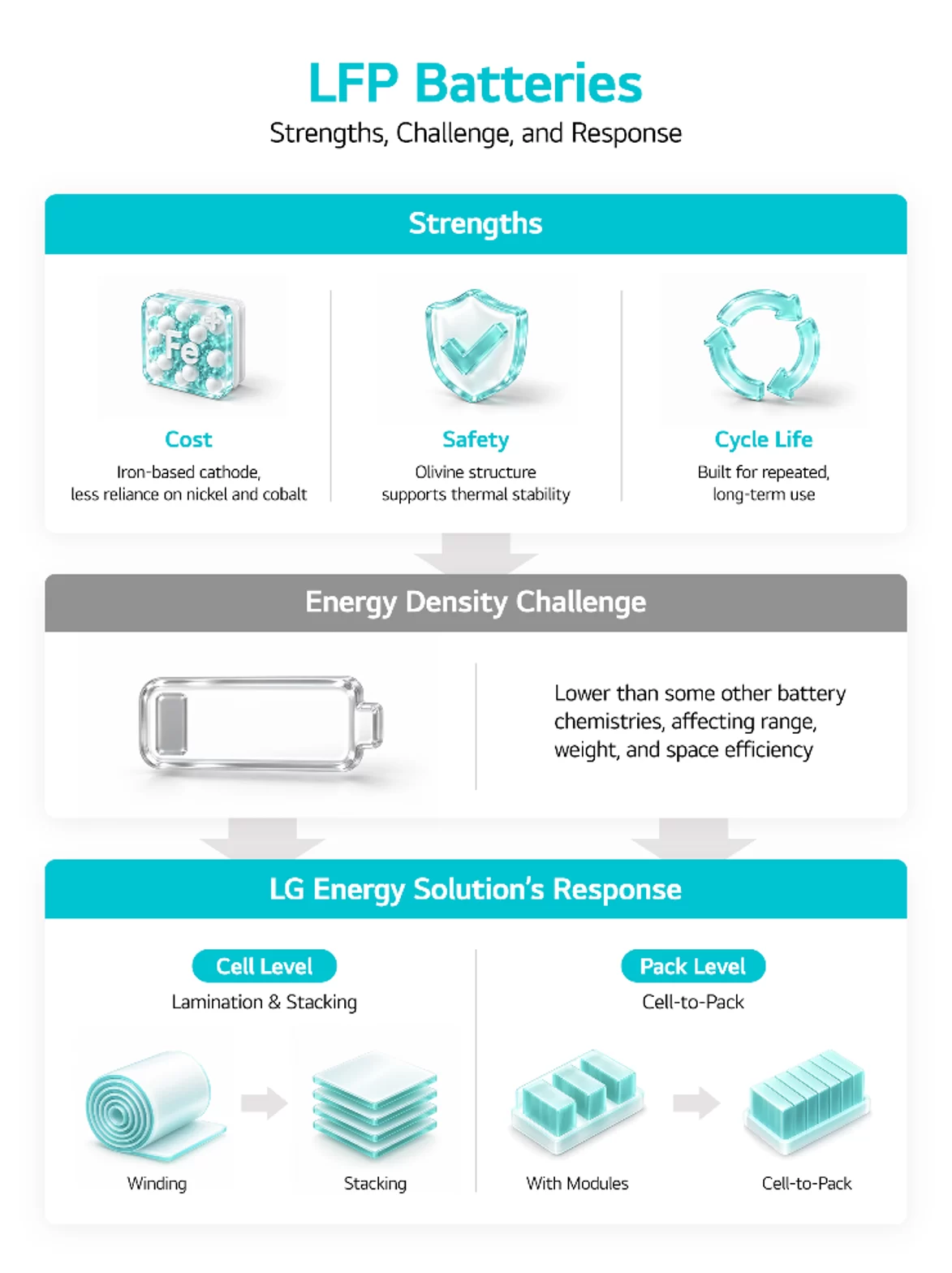
Because they use iron-based cathode materials instead of nickel and cobalt, LFP batteries can help reduce exposure to the cost and supply risks associated with certain critical battery materials. Iron’s relative abundance can also support a more diversified raw-material supply chain. Manufacturing processes, production scale, cell design, and system integration also affect the cost competitiveness of LFP battery systems.
LFP’s olivine crystal structure contributes to strong thermal stability, making the chemistry a strong option for applications where safety is a priority. In addition to cathode chemistry, cell design, manufacturing quality, battery management systems, and pack-level protections support overall safety performance.
LFP batteries’ long cycle life can enable applications that require repeated operation over extended periods, supporting frequent charging and discharging over many years. However, actual performance and costs vary depending on cell design, operating conditions, depth of discharge, maintenance, and other factors. Product-specific cycle life figures should be presented alongside the relevant test conditions to provide appropriate context for performance comparisons.
Addressing the Energy Density Challenge
Despite these advantages, improving energy density remains a major priority as LFP batteries generally offer lower gravimetric and volumetric energy density compared with some other battery chemistries. As energy density determines how much energy a battery can store relative to its weight or volume, this can influence their suitability for applications with strict weight or space constraints.
In EV applications, energy density can influence driving range, battery weight, and packaging efficiency, while in ESS applications, it can affect system footprint and the amount of energy that can be stored within a given space.
To address this, the industry is investing in advances in cell design, manufacturing processes, and pack integration while preserving LFP’s cost, safety, and cycle-life advantages. LG Energy Solution is pursuing several of these approaches across both ESS and EV applications.
Cell and Pack Innovations Supporting LFP Performance
LG Energy Solution is advancing battery manufacturing and integration technologies, including its proprietary Lamination & Stacking (L&S) process and Cell-to-Pack (CTP) technology to address these energy density challenges. These innovations address different stages in battery design, from electrode assembly at the cell level to cell integration at the pack level.
Unlike winding processes, which roll electrodes into a cell, L&S arranges electrodes and separators in carefully structured layers. This approach can support precise electrode and separator alignment while making efficient use of internal cell space, helping address LFP’s energy density challenge at the cell level. At the pack level, CTP integrates cells directly into the battery pack by eliminating the conventional module stage or reducing module-related components. This design can increase the proportion of pack volume occupied by energy-storing cells, improving pack-level space utilization. Together, these cell- and pack-level approaches deliver the greatest benefit when cell architecture, thermal management, and system-level safety design are optimized as a whole.
How LG Energy Solution Is Advancing LFP for ESS and EV Applications
Building on these cell and pack capabilities, LG Energy Solution is expanding its LFP portfolio to meet growing demand across ESS and EV markets. The company combines localized production capabilities with cell-, pack-, and system-level expertise to develop battery solutions tailored to each market’s performance, cost, and safety requirements.
For ESS applications, LG Energy Solution has been expanding LFP production capacity particularly in North America while broadening its battery portfolio. Its Lansing, Michigan facility, which began production in August 2026, produces LFP cells for ESS that are integrated by LG Energy Solution Vertech, the company’s U.S. energy storage division, into complete systems for utility, grid-scale, and commercial and industrial applications. The company is also developing multiple ESS-focused battery formats, including high-density long-cell pouch batteries and prismatic LFP batteries. LG Energy Solution incorporates pack- and system-level safety design and conducts product-specific safety evaluations, including large-scale fire testing where applicable.
For EV applications, LG Energy Solution continues to expand the use of LFP batteries through partnerships such as its supply agreement with Ampere, Renault Group’s EV-focused entity. The agreement represents the company’s first large-scale LFP battery supply contract for EVs and reflects its efforts to broaden LFP applications beyond ESS. The LFP pouch-type batteries supplied under the agreement incorporate the company’s CTP solutions to enhance cost competitiveness and safety.
Why Continued Innovation Matters for LFP Technology
LFP batteries are gaining momentum across EV and ESS markets, supported by their cost competitiveness, thermal characteristics, and cycle life. Continued advances in cell manufacturing and and pack integration will help address performance trade-offs and broaden the range of applications for the technology.
LG Energy Solution is expanding its LFP portfolio across ESS and EV applications, supported by localized production capabilities and expertise in cell manufacturing and pack integration. Its LFP portfolio includes multiple battery formats and solutions tailored to the performance, cost, and safety requirements of each market.
FAQ
Q: What are LFP batteries, and why are they becoming more popular?
A: Lithium iron phosphate (LFP) batteries are a type of lithium-ion battery that uses an iron-based cathode material. They are gaining popularity across electric vehicles (EVs) and energy storage systems (ESS) due to their cost competitiveness, thermal stability, and long cycle life. These characteristics make LFP batteries well suited to applications ranging from affordable EVs to large-scale energy storage.
Q: How can LFP battery energy density be improved?
A: Improvements in LFP battery energy density and space utilization can result from advances in cell design, manufacturing processes, and pack integration. Optimizing electrode arrangement and cell architecture can make more efficient use of internal space, while pack-level approaches such as Cell-to-Pack (CTP) technology can reduce the number of components between the cells and the pack. The resulting benefits depend on cell architecture, manufacturing conditions, and system-level design.
Q: Why is LFP battery production expanding globally?
A: Growing demand from both EV and ESS markets is driving investment in LFP battery production worldwide. The expansion of renewable energy, grid-scale storage deployments, and increasing adoption of affordable EVs are contributing to demand for LFP batteries across multiple applications.
Q: How are LFP batteries used differently in EV and ESS applications?
A: Although they use the same battery chemistry, EV and ESS applications prioritize different performance characteristics. EV batteries typically focus on driving range, weight, packaging efficiency, and charging performance, while ESS batteries emphasize cycle life, safety, reliability, and long-duration energy storage. As a result, battery design, form factor, and system integration requirements can vary significantly between the two applications.
Q: How long do LFP batteries last, and are they suitable for energy storage systems?
A: Actual cycle life varies depending on cell design, operating conditions, depth of discharge, and other factors. Their long cycle life can support repeated-use applications such as ESS, although overall lifecycle economics also depend on system efficiency, maintenance, and operating conditions.
+ To stay up to date with the latest news from LG Energy Solution, click “Subscribe.”