
- Physical AI is expanding across robotics, drones, and urban air mobility (UAM), with battery requirements extending beyond computing performance to include operating time, safety, and reliability.
- LG Energy Solution is developing application-specific battery solutions to address the diverse requirements of robotics, drones, and UAM.
LG Energy Solution is developing battery solutions for physical AI applications including robotics, drones, and urban air mobility (UAM). As physical AI evolves, battery requirements are becoming more complex, encompassing not only computing performance but also operating time, safety, and reliability across varied environments and use cases.
What Is Physical AI and Why Battery Performance Matters
From robotics and drones to urban air mobility (UAM), AI is accelerating a shift across industries, moving beyond digital environments into physical AI capable of perception, reasoning, and action in real-world environments.
The World Economic Forum defines physical AI as a combination of advances in AI, robotics, and sensing technologies that enable machines to operate autonomously in physical settings. McKinsey & Company notes that recent work in the field is opening new possibilities for these robots to interact directly with the physical world.
As physical AI becomes more sophisticated, system requirements extend beyond computing performance to include operating time, safety, and reliability. Battery technology sits at the center of those needs as critical infrastructure supporting continuous and stable operation.
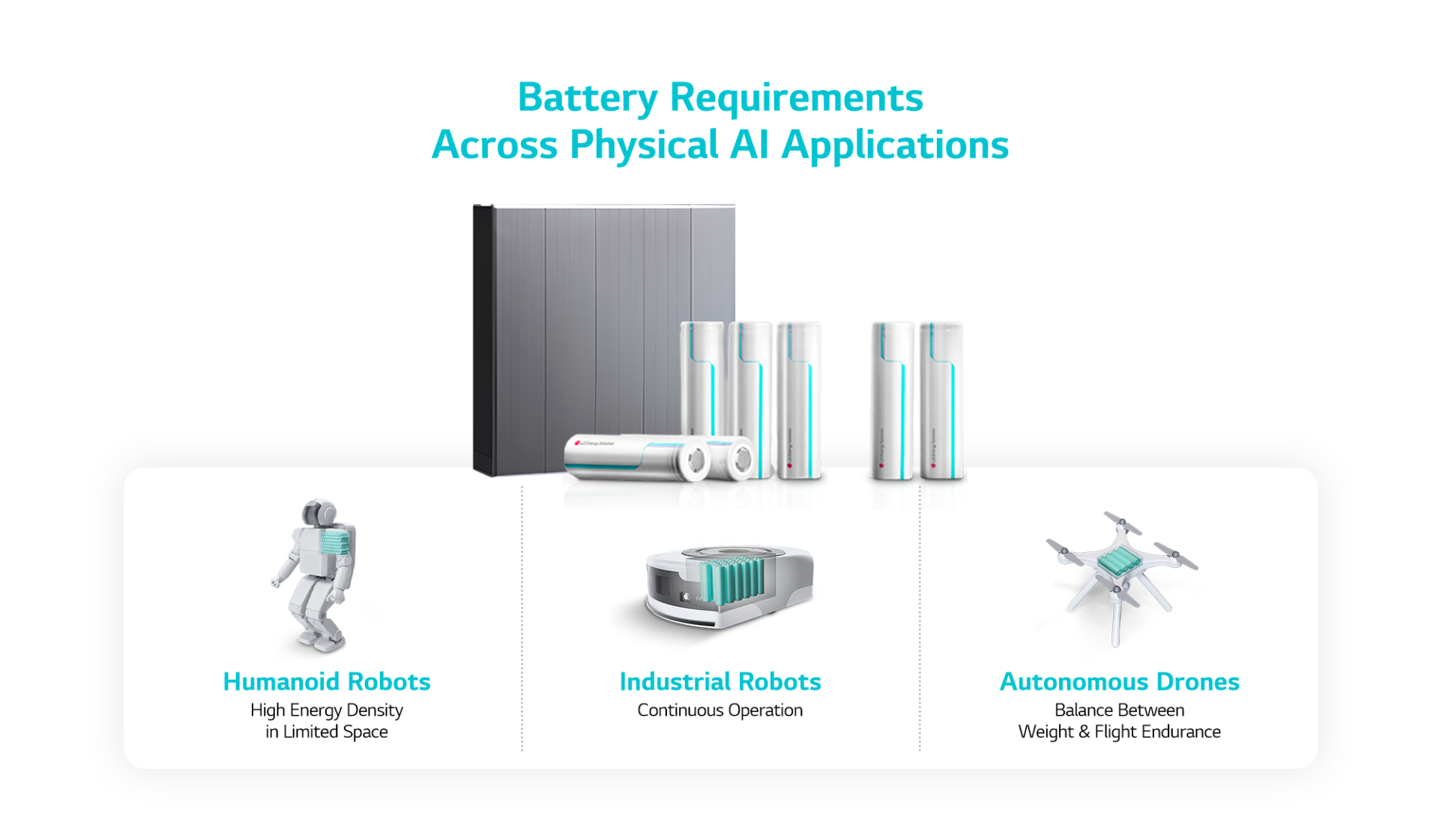
In this context, the ability to deliver sufficient energy is critical. When battery energy density and performance fall short, physical AI systems face limitations in operating time and overall efficiency.
How Battery Requirements Differ Across Physical AI Applications
Across sectors, energy autonomy is consistently identified as the key that determines the capability, reliability, and scalability of physical AI systems. However, as physical AI spans a diverse range of applications, battery requirements can vary significantly depending on operating environments and use cases.
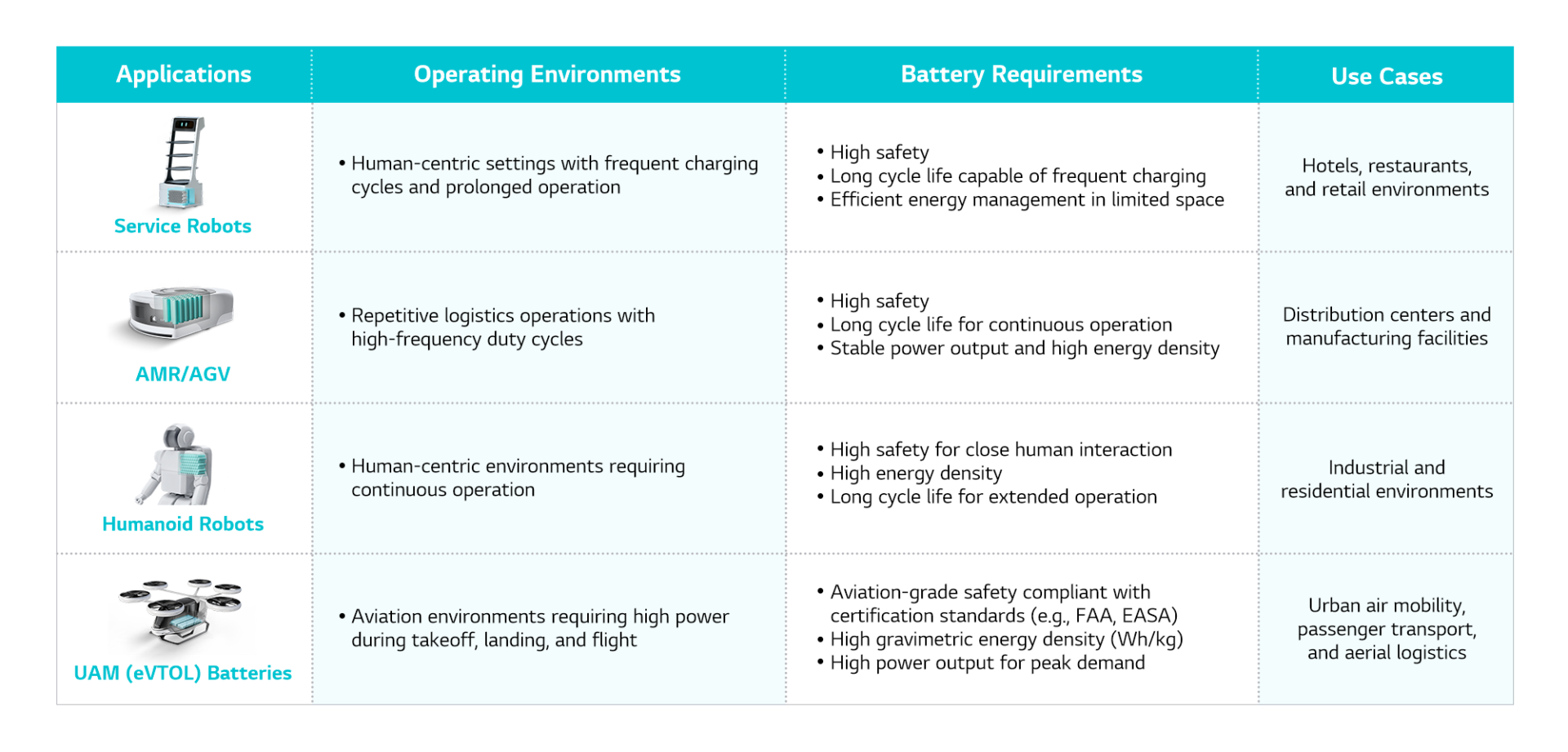
To address these requirements, LG Energy Solution is developing application-specific battery solutions tailored to the different needs of physical AI systems.
How LG Energy Solution Is Developing Battery Solutions for Robotics
In the robotics sector, LG Energy Solution’s broad battery portfolio offers optimized solutions based on each specific robot type. Within the humanoid robot segment, the company is advancing both cell- and pack-level technologies to enable stable, high-performance operation in practical scenarios.
At the cell level, LG Energy Solution is using high-capacity, long-life 2170 cylindrical batteries to support the early expansion of the humanoid robotics market. With a strong balance of energy density and durability, these cells are well-suited to continuous operation and repetitive motion. The company also plans to introduce next-generation all-solid-state batteries (ASSBs) to further enhance performance and support wider adoption of high-performance humanoid robots.
At the pack level, LG Energy Solution is developing robot-specific battery technologies to support operational continuity and safety. Hot-swappable battery systems enable battery replacement without interruption, while immersion cooling-based battery packs improve thermal management and stability.
In autonomous service robotics, LG Energy Solution entered a partnership with Bear Robotics, providing advanced materials, including high-quality NCMA cathodes and reinforced ceramic-coated separators, to ensure high levels of safety and performance. Similarly, LG Electronics’ home service robot LG CLOiD uses LG Energy Solution’s high-performance cylindrical batteries, supporting longer operation time, improved efficiency, and enhanced thermal stability.
Beyond robotics, LG Energy Solution batteries are also applied to drones for blood delivery and CubeSat satellites. In these use cases, both high power output and a lightweight design are essential. Achieving a lightweight form factor requires the use of high energy density materials in the cell design.
How LG Energy Solution Is Supporting Physical AI Applications Beyond Robotics
Building on its extensive battery technology and collaborations with robotics and UAM partners, LG Energy Solution is continuing to develop solutions that support the commercialization of physical AI. As physical AI expands into a wider range of real-world environments, application-specific battery performance will remain an important factor in supporting continuous, reliable operation.
Key Facts & Figures
- LG Energy Solution is developing application-specific battery solutions for three major physical AI application areas: robotics, drones and urban air mobility (UAM).
- For humanoid robots, the company is using high-capacity, long-life 2170 cylindrical batteries while advancing both cell- and pack-level technologies.
- LG Energy Solution is developing hot-swappable battery systems and immersion cooling-based battery packs to support operational continuity, thermal management and stability in robotics applications.
- The company also plans to introduce next-generation all-solid-state batteries and is applying its battery technologies beyond robotics to use cases including blood-delivery drones and CubeSat satellites.
FAQ
1. What is physical AI?
Physical AI brings together advances in AI, robotics, and sensing technologies to enable machines to operate autonomously in physical environments. Applications include robots, drones, and other systems that perceive, reason, and act in the real world.
2. Why are batteries important for physical AI systems?
Physical AI systems rely on batteries to provide sufficient operating time, safe operation, and reliable performance. When battery energy density and performance fall short, systems can face limitations in operating time and overall efficiency.
3. What battery requirements do physical AI applications have?
Requirements vary by application and operating environment. Depending on the use case, physical AI systems may require high energy density, long cycle life, stable power output, lightweight design, thermal stability, or high levels of safety.
4. What battery solutions is LG Energy Solution developing for humanoid robots?
LG Energy Solution is developing both cell- and pack-level technologies for humanoid robots. These include high-capacity, long-life 2170 cylindrical batteries, hot-swappable battery systems, immersion cooling-based packs, and planned next-generation all-solid-state batteries.
5. How is LG Energy Solution supporting physical AI applications beyond robotics?
LG Energy Solution batteries are also used in applications such as blood-delivery drones and CubeSat satellites, where high power output, lightweight design, and high energy density are important requirements.
+ To stay up to date with the latest news from LG Energy Solution, click “Subscribe.”
Last Updated: October 2026