
- LG Energy Solution strengthens global energy governance through structured standards and real-time monitoring systems.
- LG Energy Solution Wroclaw drives large-scale energy optimization through operational excellence and employee engagement.
As global industries move toward carbon neutrality, LG Energy Solution is strengthening its sustainability efforts by operating more efficiently and accelerating the energy transition. LG Energy Solution Wroclaw is spearheading this promise, actively reducing energy consumption via measures aligned with the company’s ESG practices.
To expand these initiatives globally, LG Energy Solution introduced structured standards and advanced monitoring systems that embed energy management into daily operations. It developed corporate regulations aligned with ISO 50001, the international energy management system standard, which it applies across all global sites through the Enterprise Standard Management (ESM) system. Additionally, a centralized Energy & Utility Management System (EUM) monitors energy usage in real time at the production equipment level, enabling the company to analyze consumption data and performance trends, identify inefficient operations and capture savings opportunities.
Another important step has been setting annual corporate energy reduction targets to drive efficiency. These targets have steadily increased from 1,430 terajoules (TJ) in 2021 to 1,767 terajoules (TJ) in 2024. Not only has LG Energy Solution achieved these goals, but it has consistently surpassed them since 2022, reflecting excellent progress in lowering energy intensity across operations.
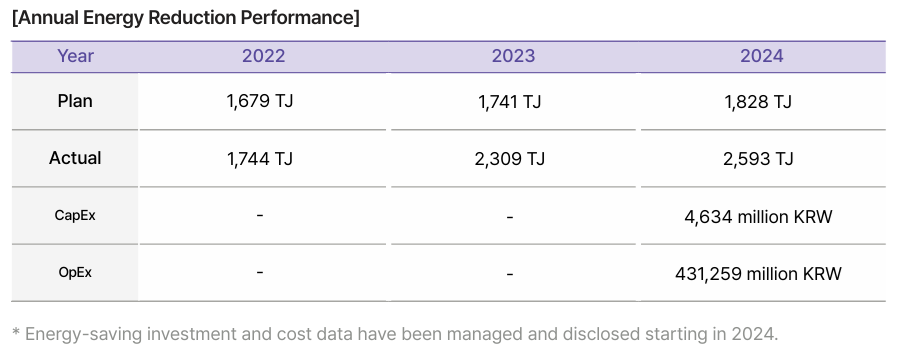
(Source: LG Energy Solution ESG Report)
To promote employee engagement, LG Energy Solution provides company-wide training on utility facilities, electrical, HVAC (Heating, Ventilation, and Air Conditioning) and refrigeration equipment, and energy management practices. This commitment to continuous education enables employees to quickly identify energy-saving opportunities and actively contribute to the company’s energy transition goals.
LG Energy Solution Wroclaw in Poland, Europe’s largest EV battery plant, leads by example. Spanning 100 hectares (1,000,000m2), the advanced technology complex has been producing batteries for major global automotive brands since 2017. Its current annual output is approximately 700,000 EV battery packs, with plans in place to increase this to one million units. The plant’s annual production capacity of 80 GWh and multinational workforce of around 7,000 position it as a key hub in Europe’s electric mobility ecosystem.
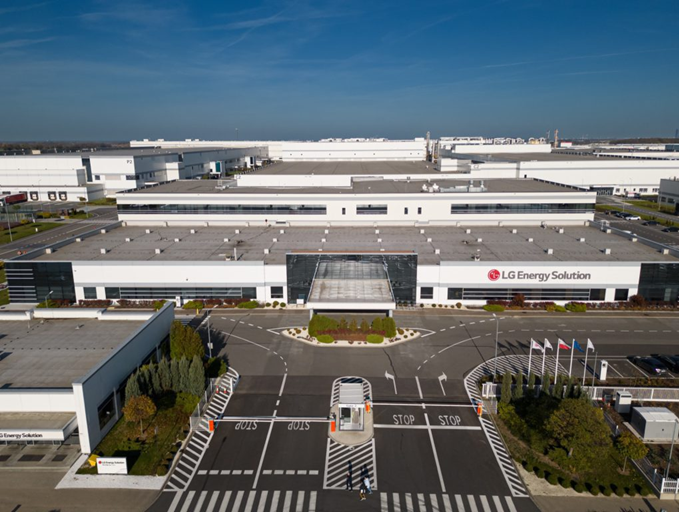
(Source: LG Energy Solution Wroclaw)
The Wroclaw facility’s sheer scale alone demands a substantial amount of energy, making its sustainable operation even more crucial. The site has implemented various measures to reduce energy use, extending beyond high-consumption production areas to include auxiliary operations and office spaces. These facility-wide improvements ensure the site maximizes efficiency gains and leverages economies of scale to achieve meaningful reductions.
The Wroclaw facility adjusts its utility equipment (e.g. HVAC systems) during low-operation periods. Its continuous monitoring of production load helps optimize the work of production devices as well as cooling, heating, and compressed air systems.
The Polish site is also fine-tuning its equipment’s operating parameters—narrowing temperature maintenance ranges, reducing pressure settings, and lowering inverter frequencies—to directly reduce its use of electricity. With inverters running at lower frequencies, any connected equipment requires less power to operate, and similar advantages are observed when HVAC systems operate in optimized temperature conditions. Additional measures include turning off equipment instead of leaving it in standby mode, regularly cleaning HVAC units, and conducting inspections and repairs of transport systems.
The office spaces around the Wroclaw facility are no exception, using a centralized building management system and a HVAC system that shuts down automatically. Additionally, there are motion sensors in lighting zones, which activate only when movement is detected, and LED lighting, which consumes 18 to 44 percent less electricity than fluorescent lighting.
When outdoor temperatures are low, these spaces also utilize natural cooling by bringing in outside air, meaning air conditioners have less work to do. For companies with similar energy demands, such strategies can reduce total energy usage, leading to significant cost savings.
A number of these measures were suggested and driven by the employees themselves. This reflects a strong culture of participation and shared responsibility, highlighting the true value of workforce engagement. Through continuous training and open communication, LG Energy Solution fosters a company-wide mindset focused on resource efficiency and a sustainable working environment.
Beyond on-site initiatives, the company improves its global energy and greenhouse gas (GHG) strategy through a structured governance framework and coordinated oversight. GHG emissions are systematically calculated and managed across all sites, including subsidiaries and JVs, using energy consumption data collected by the EUM system. The Global Energy Working Council supports this by bringing together energy and GHG leaders from each site and department to review performance, align management practices, and share best practices for continuous improvement across the organization.
Through governance structures, digital monitoring systems, employee engagement, and cross-border collaboration, LG Energy Solution puts energy efficiency at the center of its global operations. The Wroclaw facility is a glowing example of how scale and sustainability can advance together, supported by global coordination that ensures regulatory consistency and a continuous exchange of insights. This integrated approach allows LG Energy Solution to strategically navigate an evolving energy landscape with resilience.
The article is based on “Empower every possibility – dobre praktyki zarządzania energią,” featured in the Sustainable Energy Transition Guide in Poland. It was contributed by Joanna Lorenc, ESG Part Leader at LG Energy Solution Wroclaw, Aleksandra Kowal, former ESG Specialist at LG Energy Solution Wroclaw, and Natalia Napiórkowska, Manager of Strategy in the Energy Efficiency Innovation Team at LG Energy Solution Wroclaw.
+ To stay up to date with the latest news from LG Energy Solution, click “Subscribe.”