
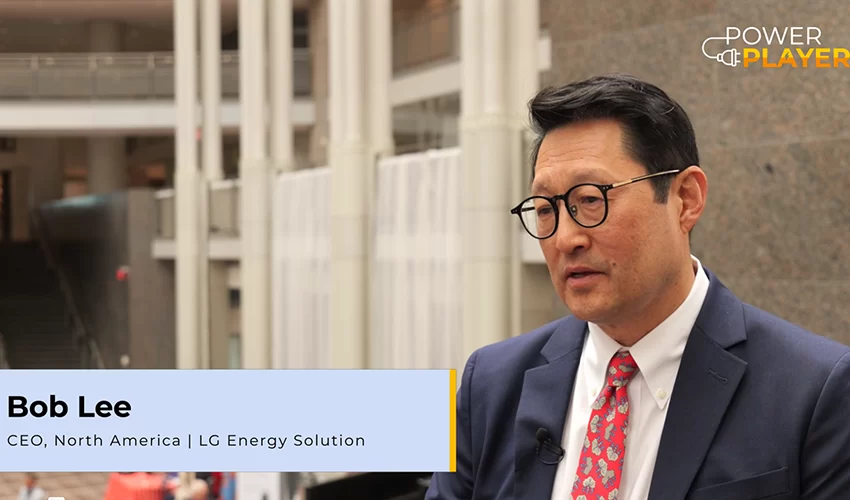
- At Giga US 2026, Bob Lee, president of North America, LG Energy Solution, explains how the company is expanding its manufacturing footprint in the region to meet growing energy storage demand.
- He highlights the importance of policy consistency in strengthening the country’s battery industry and energy security.
From June 9–10, LG Energy Solution participated in the annual Giga US 2026 conference at the Ronald Reagan Building and International Trade Center in Washington, D.C. Hosted by Benchmark Mineral Intelligence, the event brought together government officials, financiers, and industry leaders from across the U.S. EV battery and critical mineral value chain to discuss supply chain challenges. During the conference, Bob Lee, Corporate Executive Vice President and President of North America at LG Energy Solution, participated in a panel discussion and follow-up interview about U.S. energy storage policy and manufacturing amid accelerating domestic demand.
During a discussion titled “Powering the Surge: Energy Storage at the Center of America’s Grid Transformation,” Lee explored the increasing role of energy storage in the U.S. energy transition, driven by efforts to strengthen supply chain sovereignty.
Following the panel, Lee spoke with Hughes about the rapid growth of the U.S. energy storage market, LG Energy Solution’s evolving production strategy in North America, and the policy support needed to strengthen the domestic battery industry. Highlights from the interview are presented below.
(Source: Benchmark Minerals)
Q. Can you highlight some of the key changes over the last two to three years in the energy storage market and how LG Energy Solution has adapted to them?
A. The U.S. energy storage market has expanded very rapidly over the last few years, driven by the need to modernize the grid and manage power generation more efficiently. At the same time, the rise of data centers, with their high and variable power demand, has highlighted the role batteries can play in supporting grid stability.
The growth of energy storage systems (ESS) has been a tremendous development for the company, particularly as the EV market has expanded more slowly than anticipated five years ago. It required us to reallocate some of our EV battery capacity and further develop system-level technologies, including different cooling mechanisms. Adapting battery system architecture for grid applications is complex and has certainly challenged us, but it has also accelerated the development of new technologies and opened new market opportunities.
Q. Could you talk us through LG Energy Solution’s manufacturing facilities in North America, and how the mix between EVs and energy storage looks today?
A. We operate eight large-scale facilities across North America, including seven in the U.S. and one in Canada, with capacities generally in the range of 40 gigawatt-hours. Of the seven U.S. plants, one produces cylindrical EV cells, while the others primarily manufacture the pouch-type EV cells that have traditionally formed our core product portfolio. Five of the six pouch-type EV cell plants have begun converting part of their capacity to ESS LFP cells in response to growing ESS demands
In addition to changing our chemistry from high-nickel NCM to LFP, we are also developing different formats. We’ve announced projects involving prismatic cells, a format well suited to entry-level EVs and ESS applications. Our plants currently support both ESS and EV production, with stronger demand for LFP-based ESS products, while maintaining flexibility to respond as EV demand recovers.
Q. Could you tell us about LG Energy Solution’s recent energy storage offtake agreements, including the large-scale deal with DTE Energy, and how demand for the company’s energy storage cells and systems has evolved in recent years?
A. Demand for energy storage systems in large utility-scale projects has grown remarkably fast. The DTE Energy project is particularly significant because it was developed in close collaboration with the state of Michigan and DTE Energy. It’s also strategically important because the plant supplying the project is our first facility in North America, located in Holland, Michigan. Being able to deliver products made in Michigan to utilities and customers within the state creates a more localized energy storage supply chain that we are proud of.
At present, much of the U.S. ESS market is concentrated in the Southwest — in states such as California, Arizona, and Texas. However, we are increasingly seeing projects emerging in other regions. DTE Energy is leading the way in Michigan, and similar projects are now taking shape in Ohio, New England, and beyond. This trend reflects an early but growing recognition among utilities that energy storage can improve system efficiency while reducing capital investment and the cost of meeting demand.
Q. Interest in domestic products, including non-Prohibited Foreign Entities (PFE) or non-Foreign Entity of Concern (FEOC) products, has shifted with the policy landscape in the last few years. How have these policies supported LG Energy Solution, and what more could be done to help the company strengthen its cost competitiveness and leadership in the U.S. storage market?
A. We have benefited considerably from policies introduced under both the current and previous U.S. administrations, particularly battery production tax credits, for which we are sincerely grateful. These incentives have helped offset the significant upfront investment required in an industry where projects can take ten to twenty years to reach payback. As a strategic industry that furthers both energy and economic security, battery storage would benefit from more coordinated policy support.
Beyond tax credits, additional investment in research, early-stage development, and permitting reform could help accelerate construction. Given the industry’s strategic importance, securing a meaningful domestic share will require continued government support and prioritization.
Q. There is a sense that while supportive policies exist, an underlying uncertainty remains. Do you agree that greater policy certainty in the coming years will be key to helping the market evolve?
A. Absolutely. The U.S. needs a comprehensive and consistent economic policy, and energy clearly has to be part of it. As a nation, we need a longer-term view of where we are headed, rather than seeing priorities shift with every election cycle. Because the industry will shape employment and value creation across the economy, long-term planning and coordination are essential.
What I would ask of policymakers is to establish clear policy that is designed to remain consistent over time. That consistency is what gives companies the confidence to invest, take risks, and move forward. As long as uncertainty persists, businesses will hesitate — so this is the kind of support we hope to see from the federal government.

and President of North America at LG Energy Solution
As Corporate Executive Vice President and President of North America at LG Energy Solution, Lee leads the company’s regional business and growth strategy. He previously served as the company’s global Chief Strategy Officer and, from 2023 to 2024, as the inaugural CEO of the Honda–LG Energy Solution joint venture, where he helped establish the partnership and lead development of its advanced battery manufacturing facility in Jeffersonville, Ohio. Earlier in his career, he was President and CEO of Continental AG North America, overseeing a business with more than USD 10 billion in annual revenue and approximately 35,000 employees. His career also includes President of Strategy for LG Electronics’ B2B business.
+ To stay up to date with the latest news from LG Energy Solution, click “Subscribe.”